
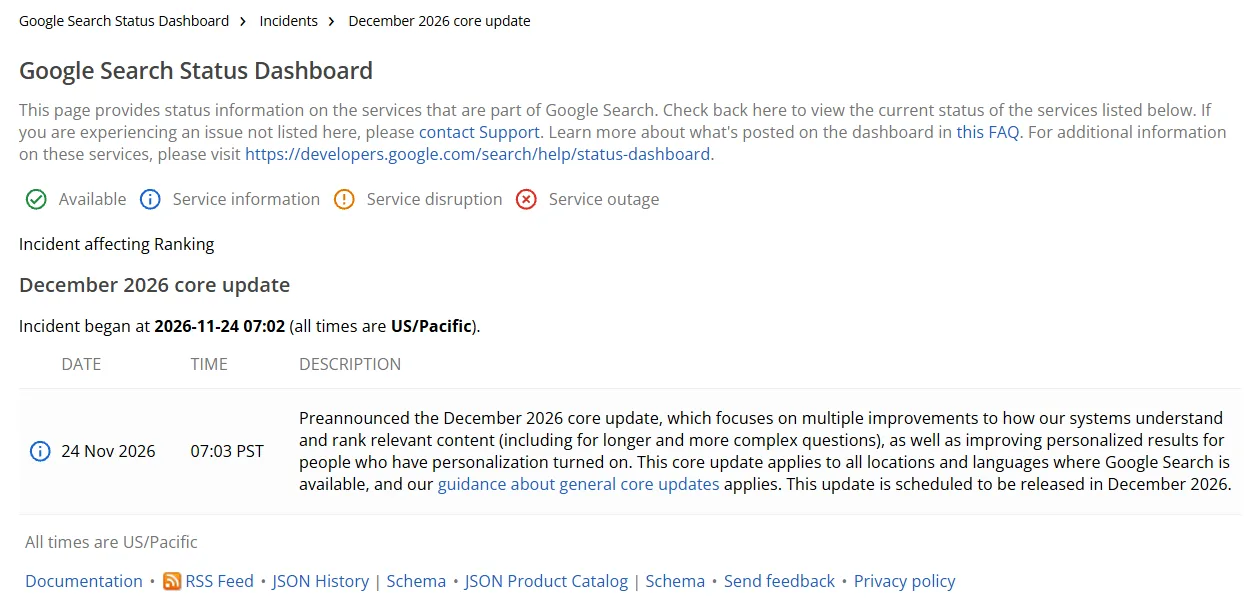
The Google December 2026 core update is coming, but it is not live yet. Google preannounced it on November 24, 2026, on its Search Status Dashboard, about an hour after the November 2026 core update finished. Google says the update will improve how Search understands and ranks content for longer, more complex questions, and will improve personalized results for people who have personalization turned on. It will roll out sometime in December 2026, in all countries and languages. No exact start date has been given.
This is the first time Google has announced a core update before it starts. Below is a plain-English guide: what Google actually said, what “complex queries” and “personalized results” mean for you, why Google changed its approach, and a simple checklist if you run a website or blog.
Google December 2026 Core Update: Quick Facts
| Detail | What we know |
|---|---|
| Announced | November 24, 2026, 7:03 a.m. PT (Search Status Dashboard) |
| Rollout date | “Scheduled to be released in December 2026” — no exact day yet |
| Is it live? | No. Google will post again on the day it starts rolling out |
| Focus | Better understanding and ranking of relevant content, including longer and more complex questions, plus better personalized results |
| Where it applies | All locations and languages where Google Search is available |
| Rollout length | Not announced. 2026 core updates took about 12 to 14 days |
| Previous update | November 2026 core update: November 10 to 24, 2026 |
What Google Actually Said
Google’s dashboard entry is short. It says the update “focuses on multiple improvements to how our systems understand and rank relevant content (including for longer and more complex questions), as well as improving personalized results for people who have personalization turned on.” It adds that the update applies everywhere Google Search is available and that Google’s general guidance about core updates still applies.
When news sites asked about timing, a Google spokesperson said there is no date yet, it is “not imminent,” and Google will announce it on the day the rollout begins, as usual. So if you see posts saying the update is already rolling out, treat them with caution until Google posts a start notice.
What Is a Google Core Update? (Simple Explanation)
A core update is a broad change to the main systems Google uses to rank web pages. It is not a penalty and it does not target one website. Think of it like a teacher re-marking all the exam papers with a slightly updated answer key. Some pages move up, some move down, and many stay where they are.
Google says a drop after a core update does not always mean your page did something wrong. It can simply mean other pages now match what searchers want a little better. Google also makes smaller core updates throughout the year that it does not announce.
What the Google December 2026 Core Update Changes
This is the first 2026 core update where Google has named a focus. Earlier notices for the March, May and November updates only gave dates. Here is what the two focus areas likely mean in everyday terms.
1. Longer and more complex questions
People now type (or speak) full questions into Google instead of two or three keywords. For example, instead of “laptop battery drain,” someone might search “why does my Windows 11 laptop lose battery overnight when the lid is closed.” Google says this update helps its systems better understand questions like this and rank content that really answers them.
For site owners, the takeaway is simple: pages that answer a specific, detailed problem clearly — with real steps and context — have a better chance than thin pages built around a short keyword. Google has not shared any technical details beyond its announcement, so nobody outside Google knows exactly which signals change.
2. Better personalized results
Personalization means Google uses information in your Google Account, such as your search history, to tailor results. According to Google’s help page on personalized results, Google only uses personalization when it is likely to be more helpful. It can change the order of results or content blocks — for example, showing videos higher if your history suggests you prefer video.
This part of the update only affects people who have personalization turned on. Signed-out users and people who switched it off will not see personalized changes, although things like location, language and device type still shape everyone’s results.
Why Google Preannounced This Update
For years, Google said it could not announce core updates ahead of time. That changed on November 24. Google published a new page, How to Stay Informed on Google Search Ranking Updates, which says it will now give notice before updates that bring new policy requirements or may cause broad ranking shifts, including core updates.
The same page links this to the UK Competition and Markets Authority’s (CMA) “fair ranking” conduct requirements for Google. Industry coverage reports that the CMA set this requirement in June 2026 and that Google must comply by December 17, 2026. Google also opened a new Search ranking hub on Search Central and a way to send feedback about ranking changes. Google says feedback helps engineers spot wider problems; it is not a way to appeal for one site.
Google Core Updates in 2026: Timeline
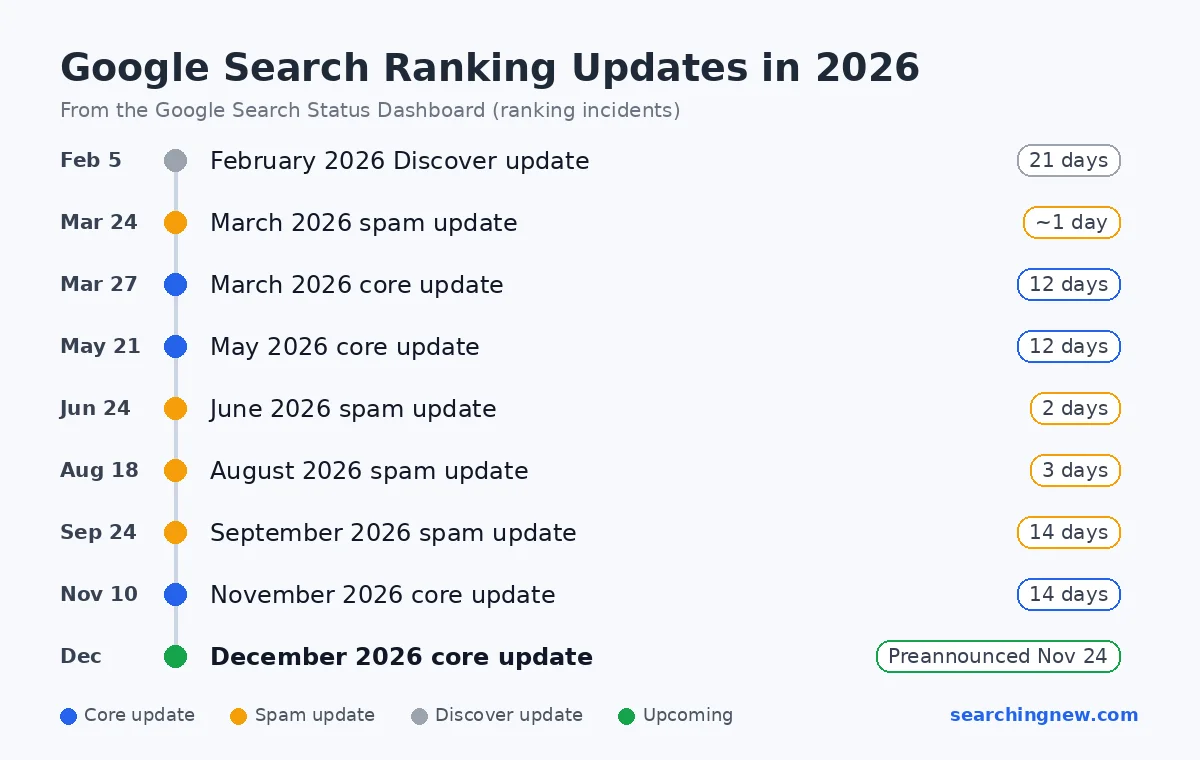
The December update will be the fourth core update of 2026. Here is every ranking update Google listed on its dashboard this year.
| Update | Started | Rollout time |
|---|---|---|
| March 2026 core update | March 27 | About 12 days |
| May 2026 core update | May 21 | About 12 days |
| November 2026 core update | November 10 | About 14 days (ended November 24) |
| December 2026 core update | December (date not set) | Not announced |
One thing to keep in mind: the December update arrives only weeks after the November update ended. If you are still reviewing November’s impact, your data may soon mix the effects of both updates.
How to Prepare for the Google December 2026 Core Update
There is no special “fix” for a core update, and Google warns against quick tricks based on SEO folklore. But a few practical steps will help you stay calm and read your data correctly.
- Save a baseline now. In Google Search Console, export clicks, impressions and top queries for a normal week before December. A week before November 10 is also useful if you are judging the November update.
- Add annotations. Search Console lets you add custom annotations to the performance chart. Mark November 24 (November update finished) and the December start date once Google confirms it.
- Check your top pages against real questions. Look at the queries in Search Console. Do your pages answer the longer questions people actually type? Add missing steps, examples or troubleshooting where it genuinely helps.
- Fix thin or outdated content. Update old posts with current information, remove repetition, and make headings clear. Google’s advice is to improve pages for readers, not to delete content as a first move.
- Keep your technical basics healthy. Make sure your sitemap works and important pages are indexed. If you use Rank Math, our guide on fixing the Rank Math sitemap 404 error covers a common problem.
- Don’t panic during the rollout. Rankings often jump around while an update is rolling out. Wait for Google to mark it complete.
What to Do If Your Traffic Drops
Google’s core update guidance gives a clear process. Here it is in simple steps:
- Wait until Google marks the update as complete on the Search Status Dashboard.
- Wait at least one more week, then compare that week in Search Console with a week before the rollout started.
- Check Web, Image, Video and News results separately to see where the drop happened.
- For a small drop, avoid big changes — especially to pages that still do well.
- For a large, lasting drop, review your whole site honestly. Google suggests asking people you trust, who are not connected to your site, for feedback, and comparing your pages with the pages that now rank above you.
Recovery can take time. Google says some changes show results within days, but it can take months for its systems to recognize that a site consistently produces helpful content. Sometimes improvements only show after the next core update.
Common Mistakes to Avoid
- Judging results mid-rollout. Daily swings during the rollout are normal and often reverse.
- Comparing holiday weeks. Late November and December include Black Friday, Cyber Monday and year-end holidays. Traffic changes may be seasonal, not caused by the update.
- Copying “recovery hacks.” Removing page elements or stuffing keywords because someone said it works is exactly what Google warns against.
- Rewriting everything at once. Change one area at a time so you can tell what helped.
- Believing fake rollout claims. Only the Search Status Dashboard confirms when the update starts and ends.
What This Means for Regular Google Users
If you just use Google to search, you don’t need to do anything. You may notice better answers for long, detailed questions. If personalization is on, results may lean a little more toward your interests. You can check whether a results page is personalized at the bottom of the page, where Google shows a note and a “Try without personalization” option. To switch personalization off completely, use the Personalized results settings in your Google Account, as explained on Google’s help page.
Google’s AI Overviews and AI Mode also draw on its ranking systems, so changes in how pages rank can affect which sites get linked there too. If you’re curious how Google’s AI compares with others, see our ChatGPT vs Gemini vs Claude comparison.
Frequently Asked Questions
Is the Google December 2026 core update live?
No. As of November 26, 2026, it has only been preannounced. Google will post a separate notice on the day the rollout begins.
When will the December 2026 core update roll out?
Google says it is scheduled for December 2026 but has not given a date. A Google spokesperson said it is “not imminent.”
How long will the rollout take?
Google hasn’t said. The three earlier 2026 core updates each took about 12 to 14 days.
Will this update affect all countries?
Yes. Google says it applies to all locations and languages where Google Search is available.
Do I need to change my website before the update?
Not urgently. Google’s guidance for core updates stays the same: focus on helpful, reliable content written for people. Use the time to save baseline data and improve pages that don’t fully answer your readers’ questions.
Why did Google announce this core update early?
Google’s new advance-notice policy covers updates that may cause broad ranking shifts. Google links it to the UK CMA’s fair ranking requirements. The December update is the first core update announced this way.
Final Thoughts
The Google December 2026 core update is worth watching, mainly because Google has told us its focus for once: complex questions and personalized results. That doesn’t change the basic advice. Write clear pages that answer real questions, keep your site in good technical shape, save your Search Console data, and wait for Google to confirm the rollout has finished before you judge the results. We’ll keep an eye on the Search Status Dashboard for the start date.
Running a WordPress site? Our guide to updating WordPress 7.0 and 7.1 safely is a good next step to keep your site healthy.